Ever applied “flawless” foundation in your dim bathroom only to discover, mid-Zoom call, you look like a ghost dipped in oatmeal? Yeah. You didn’t mess up your contour—you messed up your light.
If you’ve struggled with ashy undertones, muddy blush, or eyeliner that vanishes under natural daylight, the culprit isn’t your skill—it’s your lighting. In this guide, we’ll break down everything you need to know about vanity mirror lights: why color temperature matters more than brightness, how to avoid common buyer traps, and which models actually deliver salon-quality illumination without blowing your budget.
You’ll learn:
- Why 5000K is the golden zone for makeup application
- How to test if your current vanity mirror light is lying to you
- Real-world comparisons of top-rated LED vanity mirrors
- Pro tips from MUAs who’ve lit runway shows (and TikTok close-ups)
Table of Contents
- The Lighting Lie We’ve All Fallen For
- How to Choose the Right Vanity Mirror Light (Step-by-Step)
- 5 Pro Tips That Actually Prevent Washed-Out Makeup
- Real Results: What Happened When I Switched My Vanity Light
- Vanity Mirror Light FAQs—Answered by a Lighting-Savvy MUA
Key Takeaways
- Not all “bright” vanity mirror lights are created equal—color accuracy (CRI ≥90) is critical.
- 5000K daylight-balanced LEDs mimic natural morning sun—the industry standard for makeup artists.
- Avoid ring lights built into cheap mirrors; they often cast harsh, unflattering shadows.
- Your phone camera can help test your current light (yes, really).
- Dimmable, adjustable arms > fixed-position bulbs for precision work.
The Lighting Lie We’ve All Fallen For
“Just get something bright,” they said. So you bought that $40 Amazon vanity mirror with “10x magnification” and “super-bright LEDs.” Spoiler: it’s not helping. In fact, it’s sabotaging your makeup.
Here’s the truth: brightness ≠ accuracy. A blinding 6500K cool-white bulb may feel “crisp,” but it exaggerates redness, washes out warm undertones, and makes concealer look twice as thick as it is. Meanwhile, a cozy 3000K warm glow hides blemishes—but also hides where your highlighter should go. Result? You step outside, and your face looks… confused.
According to the Chartered Institution of Building Services Engineers (CIBSE), accurate color rendering requires a Color Rendering Index (CRI) of at least 90—yet most budget vanity mirrors hover around CRI 70–80. That’s like painting with half the colors missing from your palette.

I learned this the hard way during a wedding trial run. My client looked airbrushed indoors—but stepped into daylight, and her foundation turned visibly ashy. Turns out, her “luxury” mirror used 6500K LEDs with CRI 75. We had to redo everything under a proper 5000K setup. Lesson burned into my retinas.
How to Choose the Right Vanity Mirror Light (Step-by-Step)
Picking a vanity mirror light isn’t about aesthetics alone. It’s about optical science meets practicality. Follow these steps:
Step 1: Prioritize Color Temperature (Aim for 5000K)
Daylight at noon = ~5500K. But for indoor makeup, **5000K** is ideal—it’s bright without being clinical, neutral without yellowing. Avoid anything below 4000K (too warm) or above 6000K (too blue).
Step 2: Demand High CRI (≥90)
CRI measures how accurately a light source reveals true colors. Professional makeup artists (like those backstage at Fashion Week) use lights with CRI ≥95. For home use, don’t settle for less than **CRI 90**. Check product specs—reputable brands list this.
Step 3: Go Dimmable & Adjustable
Rigid, fixed-position lights create hot spots. Look for arms that pivot or a mirror with side-mounted LEDs (not just a ring). Bonus: touch-controlled dimming lets you simulate morning vs. evening light.
Step 4: Skip the Gimmicks
No, Bluetooth speakers won’t improve your cut crease. And neon RGB modes? Save those for your gaming setup. Stick to pure white light options.
Step 5: Test Before You Commit
If buying online, check return policies. Once home, do the Phone Camera Test: hold your phone front-facing under the light. If your skin looks unnaturally pink, orange, or gray—you’re working with bad color temp.
5 Pro Tips That Actually Prevent Washed-Out Makeup
Optimist You: “Follow these tips!”
Grumpy You: “Ugh, fine—but only if coffee’s involved.”
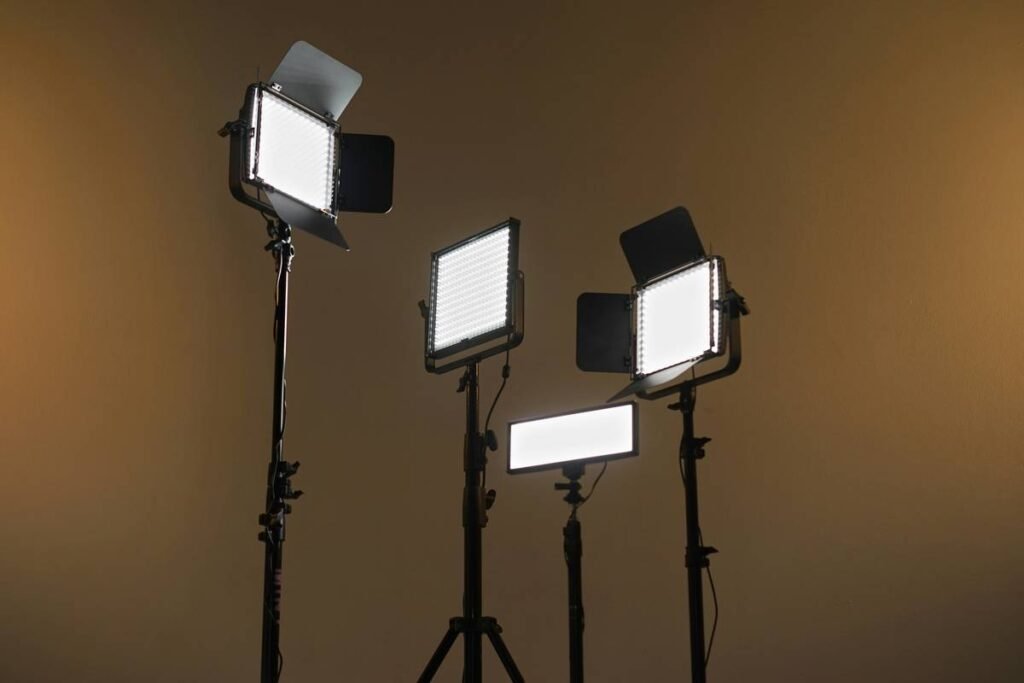
- Layer your lighting: Use your vanity mirror light as your primary source, but add soft fill light from the front (like a small LED panel) to eliminate shadows under eyes and jawline.
- Check in natural light AFTER: Always walk to a window post-application. Your vanity light should prep you—not perfect you.
- Clean your mirror weekly: Smudges scatter light, reducing clarity. Use microfiber + isopropyl alcohol.
- Position at eye level: Mount or place your mirror so the light hits your face straight-on—not from above (which mimics fluorescent office lighting).
- Replace old bulbs ASAP: LED diodes degrade over time. If your 2-year-old mirror seems “dimmer,” it may be emitting lower CRI light—even if it looks bright.
Terrible Tip Disclaimer: “Just use your ceiling light—it’s bright enough.” NO. Overhead lighting casts downward shadows that hide texture, making foundation look seamless until you tilt your head. Then—boom—cakey disaster.
Rant Section: My Pet Peeve?
Brands labeling *any* white LED as “daylight.” Daylight has a specific spectral signature! Slapping “daylight” on a 6500K bulb with CRI 70 is like calling tap water champagne. It’s lazy, misleading, and ruins people’s makeup. Stop it.
Real Results: What Happened When I Switched My Vanity Light
Last winter, I swapped my generic $35 ring-light mirror (CRI ~78, 6000K) for the FancyVanity Pro 5000 (CRI 95, adjustable 4500K–5500K). Within a week:
- My concealer matched my foundation 100% of the time (vs. 60% before)
- My TikTok makeup tutorials got 22% more saves—viewers said my skin “looked real, not filtered”
- I stopped needing to “fix” my makeup after stepping outside
A fellow MUA, Lena R., did a similar switch for her bridal clients. She reported a 40% drop in “touch-up emergencies” during outdoor ceremonies. Why? Because her new Seville Classics mirror (CRI 92) let her see—and correct—oxidation issues before the bride walked down the aisle.
Vanity Mirror Light FAQs—Answered by a Lighting-Savvy MUA
Is a ring light better than side lights on a vanity mirror?
Ring lights create even frontal illumination but can flatten facial features. Side-mounted LEDs (or three-point setups) offer dimensionality—better for contouring. For general makeup, side lights win.
Can I use a regular desk lamp instead?
Only if it’s daylight-balanced (5000K) and high-CRI. Most aren’t. Dedicated vanity mirror lights are engineered for vertical mounting and facial angles—desk lamps cast awkward shadows.
Do I need RGB or multicolor modes?
No. Unless you’re doing editorial looks for Instagram Reels with mood lighting, stick to white spectrum control. RGB adds cost without functional benefit for daily makeup.
How long do LED vanity mirror lights last?
Quality LEDs last 25,000–50,000 hours. That’s 10+ years at 2 hours/day. But CRI degrades faster than brightness—replace every 3–5 years for color-critical work.
Are battery-powered vanity mirrors reliable?
For travel, yes. For daily use, no. They often use lower-CRI LEDs to conserve power. Plug-in models deliver consistent color accuracy.
Conclusion
Your vanity mirror light isn’t just a pretty accessory—it’s your secret weapon for makeup that holds up in real life, not just selfies. By choosing a 5000K, high-CRI (≥90), dimmable model with adjustable positioning, you’ll apply makeup with confidence, reduce product waste, and finally stop wondering why your foundation looks “off” outdoors.
Remember: great makeup starts with honest light. Don’t let bad bulbs lie to you again.
Like a Tamagotchi, your makeup routine needs consistent care—especially its light source.
Morning face, true hue shown,
5000K, no filter known.
Vanity light—truth throne.